What Happens In EMDR Therapy?
So you’re curious about Eye Movement Desensitization & Reprocessing (EMDR) therapy. Let me tell you a bit more about the EMDR “process” (no pun intended), because it’s a bit more involved than just eye movements!
To start, here’s a 10-minute video from the EMDR International Association, or EMDRIA, to learn more about trauma and how counselors treat trauma with EMDR:
Now that you know why EMDR is helpful, let’s talk about the eight phases of treatment. Understanding the different phases can help us understand why therapy might take more time than you’d expect, or why we have sessions that feel like ‘talk therapy’ at certain times.
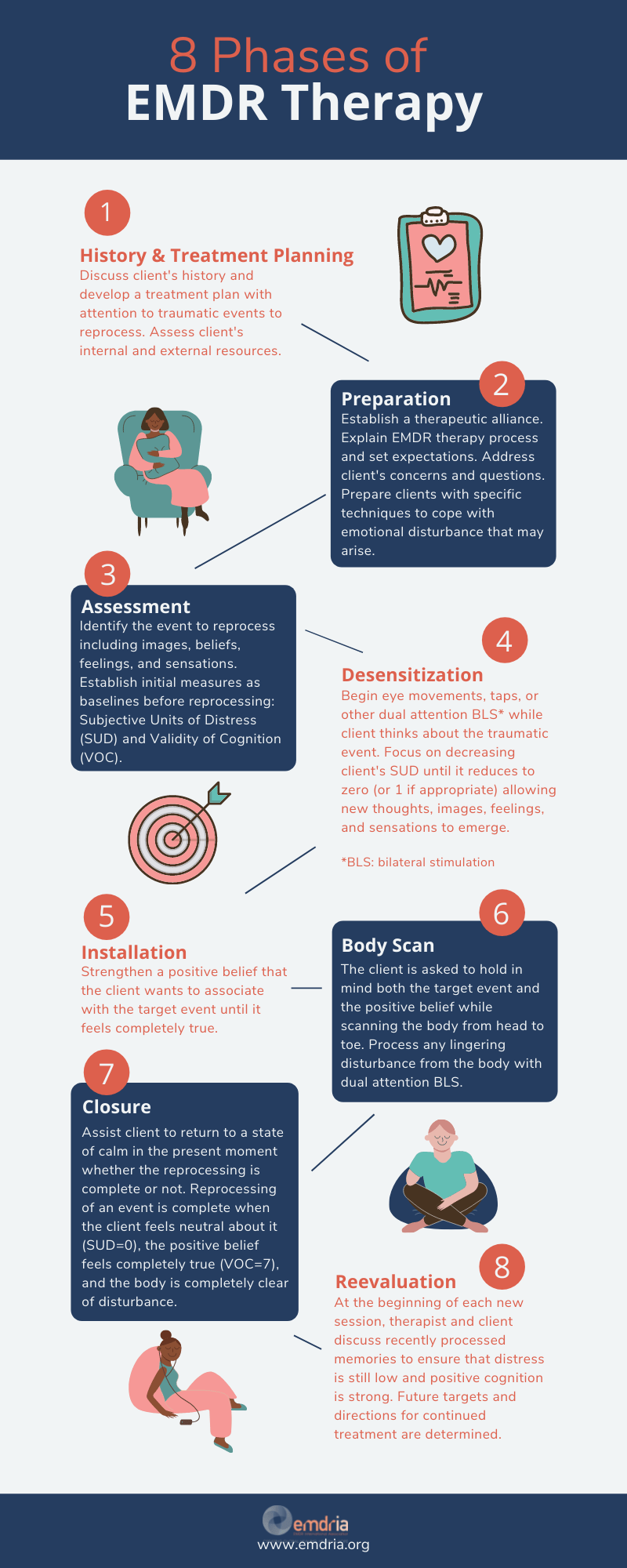
The eight phases are: 1) history taking and treatment planning, 2) preparation, 3) assessment, 4) desensitization, 5) installation, 6) body scan, 7) closure and 8) reevaluation.
The first step in any therapy will be an intake appointment, at which time I will get to know you and help you describe the problem(s) bringing you to therapy. We will talk about your personal and family history with mental health, physical health, and substance use. I’ll ask you about how you take care of yourself, how you’re functioning at work and home, and your relationships. During the first few sessions, you and I will continue exploring your history - which includes traumatic experiences and how you’ve coped over time. We will establish a basic treatment plan based on your needs and goals. We will also take note of your resources: these are your personal strengths and skills, supportive relationships, positive experiences, valued activities, and supportive/safe environments that help you move through the world.
Next, if you and I agree that it could be helpful to process trauma through EMDR therapy, I will help you to understand the process and set realistic expectations for therapy. It’s really important that you feel as safe and empowered as possible, so I will be available to answer any questions and discuss any worries or concerns you may have.
As we get closer to processing, it will be important for us to find some coping strategies that work for you. For some, your existing resources are good enough! For others, we will need to learn new tools. What I will be looking for is the ability to stay emotionally present in the room while we work through hard things. Being totally ‘calm’ or neutral in the therapy space is never my expectation, and can sometimes be a sign that someone is not feeling safe.
We will identify the event(s), or targets, that need to be reprocessed, based on what’s giving you the most distress. Sometimes, we start with what is bothering you now and move backward to earlier experiences. Sometimes, there is one awful event that we can break down into smaller parts.
We will explore what these traumatic events “taught” you about yourself, even if it doesn’t make logical sense - for example, an abusive relationship may lead a person to believe deep down that ‘it was my fault’, even if their logical mind can see that is unfair. We will then explore, for each belief, a positive belief that you’d like to have when you think back to these traumatic events. It is common to not believe these positives at first, and it is common for these positive ‘goal’ beliefs to change as you reprocess. We will rate how distressing each memory is now (on a scale of 1-10) and rate how true the positive beliefs feel now, as baseline measurements.
During a reprocessing session, we will focus on one identified target and one belief at a time. I will ask you a series of questions to get you thinking about the target, then we will start using eye movements, tapping, hand drumming, or other dual-attention bilateral stimulation (BLS). Dual attention refers to the combination of here-and-now sensory input from the eye movements or tapping, along with thinking about the memory. (It strains your working memory functions to help you reprocess the experiences.)
It’s totally normal to feel silly or awkward or worry that you’re ‘doing it wrong’ during BLS. This is where reprocessing starts. We continue the dual attention BLS until your distress is a 0/10, which may not happen in one neat session. Some memories hold a lot of emotional charge and may need multiple sessions to see progress. We also use BLS to strengthen the positive beliefs you’re wanting to associate with each target, which can also bring up important feelings. After reprocessing, we will use a body scan technique to see if your body is giving us any new information or reactions to be addressed.
At the end of every reprocessing session, we practice a coping technique to close up the work for the day and help you transition more smoothly to the outside world. At the following session, you and I will talk about your reactions and discuss recently processed memories to ‘check’ our work and decide on next steps.
It is common to have emotional reactions, dreams, or extra sensitivity with others in the day or two after these sessions - it can be helpful to think of this as you digesting a heavy emotional ‘meal’. I always recommend letting a trusted person in your life know when you are engaging in EMDR therapy, so you’re not digesting on your own.
If you’re interested in exploring EMDR therapy for yourself, please schedule a free intro call or book an intake appointment with me using the ‘Book Now’ button at the top of this page!